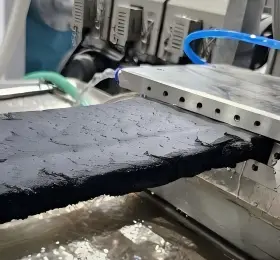
why are both the vacuum tank and the spray tank essential in PE pipe extrusion line?
In PE pipe extrusion line, why are both the vacuum water tank and the spray water tank essential?
PE pipe extrusion line: roles of the vacuum water tank and the spray water tank
When PE pipes are extruded from the die, they exist in a high-temperature molten and softened state, lacking a fixed outer diameter and circularity; therefore, rapid shaping and cooling are essential to prevent the pipes from collapsing, deforming, or deviating from specified dimensional tolerances. The vacuum water tank performs diameter setting and shaping, whereas the spray water tank continues the cooling process; the two systems serve distinct functional roles.

1. Vacuum water tank (vacuum constant-diameter tank, core shaping section)
Function: To "suck" the flexible PE pipe, fix its outer diameter and circularity, and simultaneously perform preliminary cooling. Principle: The water tank is filled with water, and a vacuum is created inside the tank, resulting in negative pressure within the tank; the outer wall of the pipe is then pressed tightly against the inner wall of the diameter-fitting sleeve by atmospheric pressure, which forcibly expands the molten PE pipe to its standard outer diameter, ensuring that the pipe maintains its circularity without flattening.
· Immediately after leaving the die head, the pipe material is at a high temperature and remains soft; at this stage, one must avoid sudden, large-volume pouring of cold water, as this would cause rapid cooling of the surface while the interior remains molten, potentially leading to high internal stresses, cracking, and deformation of the pipe wall.
· The water temperature in the vacuum chamber is typically maintained between 30–50 °C; the warm water is used for shaping, gradually dissipating heat.
· Locking the outer diameter using vacuum negative pressure is the most critical station for ensuring the dimensional tolerances of the pipe material and preventing ovality.
· Simultaneously, the water film envelops the piping, providing initial cooling that promotes the formation of a solid skin layer on the pipe surface; this layer imparts sufficient rigidity to prevent pipe collapse.
In the absence of a vacuum water tank, the extruded PE pipe will become soft and saggy, exhibit inconsistent outer diameters, and display excessive ovality, making it impossible to meet the national standard dimensions.
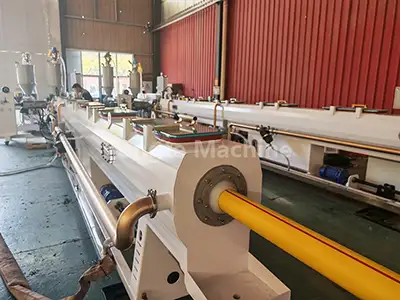
2. Spray water tank (cooling water tank, rear cooling section)
Function: To achieve deep and sustained cooling, bringing the entire pipe to a temperature close to ambient temperature. After vacuum shaping, the outer wall of the pipe has already solidified, but the inner temperature of the pipe wall remains high, and the core layer remains soft; consequently, the pipe will still deform under mechanical stress. The spray chamber utilizes high-pressure water mist to evenly spray the outer wall of the pipe from all sides, continuously dissipating the internal heat of the pipe wall:
· Multi-stage zoned spraying, with lower water temperature (room temperature);
· Apply uniform spray from all sides to prevent pipe bending caused by unidirectional cooling;
· Gradually reduce the overall temperature of the pipe material until the entire pipe wall has fully hardened and the pipe enters the pulling machine;
· Compared to immersion cooling, spray cooling is less prone to causing bubbles to adhere to the pipe walls, provides more uniform cooling, and results in lower internal stresses in the piping material.
If only a vacuum chamber is used and no spray chamber is present, the temperature in the core region of the tube will be high, causing the tube to stretch and deform under pulling forces; after cutting, it is prone to rebound and bend.
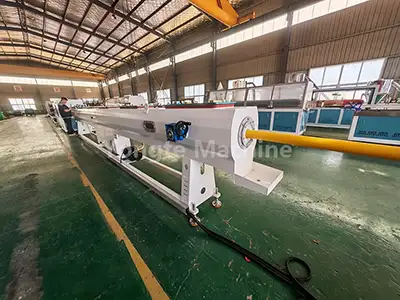
sum up
Vacuum tank = primarily for shaping, with mild cooling: negative pressure is applied to the tubing to ensure the outer diameter and roundness;
Spray water tank = Primarily for cooling, with auxiliary stabilization: fully cool and harden the piping materials from the exterior to the interior to prevent subsequent deformation.
Thus, these two processes are sequential and functionally complementary key steps in the PE pipe extrusion molding process; the absence of either one would make it impossible to produce PE pipes that meet the required dimensional precision and mechanical performance specifications. Consequently, both are indispensable components of the production line configuration.
Related News
- Advantages of Rubber Soaker Irrigation Pipes vs Traditional Irrigation Tubes
- Can Yongte Supply Turnkey Project Service for WPC decking plant?
- 200x50mm Recycled Solid Plastic Lumber Machine Tested Successfully
- Yongte WPC Column making machine with co-extrusion is successfully tested
- How can plastic film wastage be used to produce wood-plastic composite (WPC) products?
- WPC Extrusion Machine Temperature Setting
Leave me a message