Causes of screw sudden fracture during operation of WPC granulator extruder
Causes of screw sudden fracture during operation of WPC granulator extruder
Causes of sudden fracture during operation of the parallel twin-screw threaded block (compression block/transportation block)
Yongte WPC granulation extruder is equipped with a parallel twin-screw extruder, in which the screws consist of a central shaft and modular threaded blocks. The threaded block materials selected are WR4 or WR7, which provide excellent wear and corrosion resistance; accordingly, the screws exhibit outstanding durability under these operating conditions. During production, however, the threaded blocks are continuously subjected to combined shearing, compression, and friction stresses. If any abnormality occurs in these processes, it may induce a sudden fracture failure in the threaded blocks, directly causing a production line shutdown and resulting in considerable downtime losses and maintenance costs for the enterprise. The following sections systematically analyze the potential causes of sudden fracture failures in the threaded blocks of parallel twin-screw extruders.
The fracture of WPC granulator extruder parallel double-screw threaded components represents a brittle fracture mode; it is rarely caused by a single factor such as instantaneous overload, but rather results from the combined effects of material defects, stress concentration, and operational shock loads. These causes can be classified into four major categories: the material itself, machining and assembly processes, manufacturing and operating conditions, and equipment malfunctions.
Differences: Fracture typically involves fragmented pieces with a brittle fracture surface and no significant plastic deformation; wear manifests as gradual thinning; torsional failure is usually caused by exceeding the allowable torque limit for the screw.
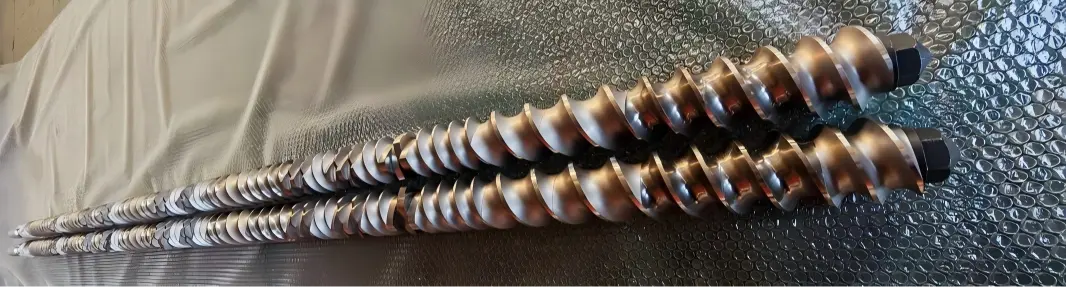
1、Materials and heat treatment defects
1. Heat treatment failed
The nitrided layer is too thick, resulting in high brittleness; the base material lacks sufficient tempering, leaving residual internal stresses; upon exposure to operating heat, these stresses are released, leading to direct fracture;
Quenching crack: Micro-cracks were generated during the blank quenching process; these cracks were not detected during the factory inspection, but they propagated during operation, leading to an instantaneous fracture.
2. Raw material inclusion, porosity, or cavities: Internal inclusions or shrinkage cavities in forged or cast parts constitute inherent defects. Under normal operating conditions, stress is concentrated at these defect sites; any fluctuation can cause these defects to rupture instantly.
3. Incorrect material selection: a high-filler (fiberglass, calcium carbonate, carbon black) formulation was mistakenly used with ordinary nitrided steel; a high-corrosion resistance formulation was applied to hot-work steel without molybdenum, resulting in the erosion of the substrate and the formation of micro-cracks.
Yongte WPC granulation extruder equip high quality screw and barrel, so it will not damage because of materials and heat treatment defects. our screw material is WR4, WR4 is a high-performance wear-resistant alloy material, mainly used in the manufacturing of key components of industrial equipment, especially in twin-screw extruders, mixing components and other fields. In addition, WR4 can further strengthen the surface properties through surface nitriding or tungsten carbide spraying process to form a wear-resistant layer of thickness 0.1~0.3mm, with hardness up to HV1200~1500, which is suitable for raw material processing containing high hardness fillers (such as quartz powder and metal powder).
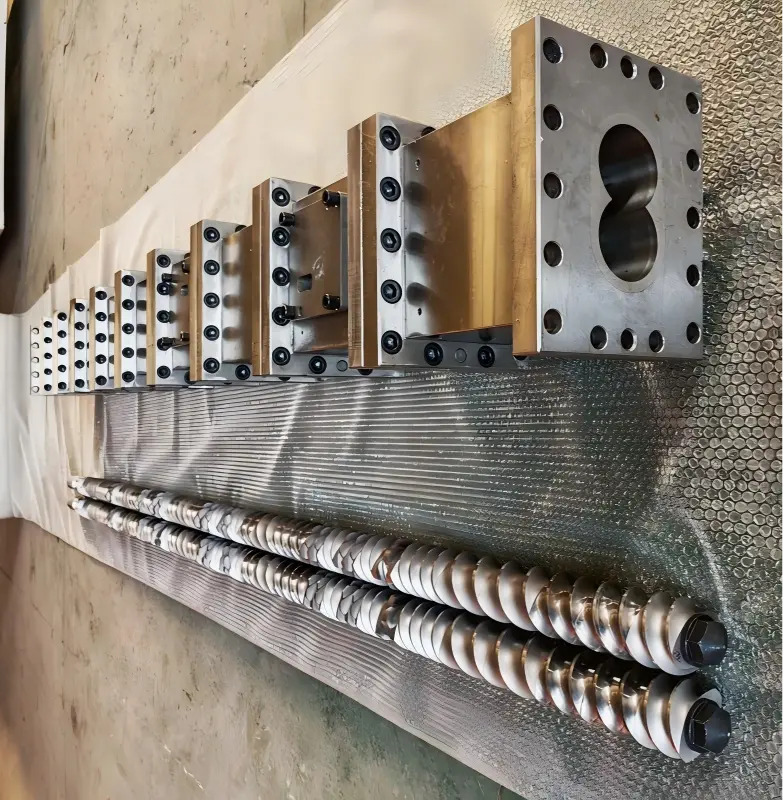
2、Mechanical assembly and structural stress analysis
1. Excessive axial preload: The threaded block is secured by a locking nut; if the preload is set too high, the threaded block is subjected to continuous high static pressure; upon heating, the thermal expansion effect superimposes on this condition, causing the internal compressive stress to exceed the material's fracture limit.
The axial clearance between the twin screws is critical: if the clearance is too small, the screws will expand due to heat, causing the end faces of the threaded blocks to compress and fracture.
2. Keyway/inner hole stress concentration: The sharp corners or excessively small fillets of the inner hole keyway constitute stress concentration points; an overly tight key fit can induce micro-cracks at the keyway notch, which then continue to propagate.
3. The threaded mating surface is uneven or contains foreign objects; the end surface may have burrs, iron chips, or material debris; after assembly, local point contact occurs on the end surface, resulting in localized high pressure during operation, which can lead to cracking at the contact points.
4. Poor screw alignment (non-circularity between the two screws); wear on the coupling or bearing housing; excessive coaxiality deviation between the two parallel screws; the threaded blocks are subjected to periodic alternating bending stress, leading to fatigue fracture.
3、Process operating condition impact (instantaneous load triggering fracture)
1. Cold-start / Material blockage-induced hard-start: As the material inside the barrel cools and solidifies, the screw is forcibly started, resulting in an instantaneous torque that far exceeds the rated torque; this generates a tremendous impact load that directly fractures the screw block – the most common accident scenario encountered on-site.
2. Foreign objects entering the barrel (e.g., hard metal objects); nuts, gaskets, screw shavings, or metal tools falling into the hopper and becoming lodged between the threaded block and the barrel, generating a transient compressive impact.
3. Local overheating and sudden changes in thermal stress: the local temperature rises sharply and then drops rapidly; this alternating thermal cycling induces thermal shock cracks; particularly for nitrided components, their thermal shock resistance is poor.
4. Excessive material filling or sudden pressure changes, a sharp increase in feed rate, or a blocked exhaust port can cause the head pressure to spike instantaneously, subjecting the threaded block to significant circumferential and axial forces.
4、Fatigue damage accumulation (pre-existing hidden cracks, sudden onset)
The threaded component is subjected to alternating torque and alternating stress over an extended period, causing microcracks on its surface to gradually propagate; these damages are not visible to the naked eye. However, when the cracks reach a critical size, they suddenly propagate without any prior warning, giving the appearance of "suddenly failing."
Fast on-site inspection method (visual inspection of the fracture surface)
· The fracture surface exhibits old cracks and a shell-like pattern: fatigue fracture (resulting from long-term alternating stress, not instantaneous impact).
· Flat and bright cross-sections with brittle grains: heat treatment-induced brittleness / cracking in the nitrided layer
· The fracture surface exhibits compressive deformation and metal scratches; foreign object impingement-induced fracture.
· The fracture originates at the inner hole keyway location: keyway stress concentration
Corresponding preventive measures
1. Material procurement inspection: perform non-destructive testing and hardness testing on forgings; verify material qualification reports; control the nitriding layer depth for nitrided components to prevent the formation of brittle nitrided layers.
2. Assembly: Strictly control axial preload and verify the coaxiality of the screw; clean the end surface thoroughly and round the step edges.
3. Operating Procedure: Do not forcibly start the chiller; ensure the blocked material is heated sufficiently to melt it before operating the drive; install a hopper magnet for iron removal.
4. Daily inspection: Monitor the main unit's torque and head pressure fluctuations; perform regular inspections of the thrust bearings to prevent axial displacement.

Related News
- Large Parallel Twin-Screw Plastic Recycling Extruders for African Client Under Production
- Yongte plastic recycling extruder running in Africa
- How many molds are needed for one set of door frames?
- Integrated Anti-Bridging Feeding System for Recycled Plastic Extrusion
- Yongte Rubber Foam Microporous Seepage Pipe Production Line Successfully Commissioned for Indian Client
- Advantages of Rubber Soaker Irrigation Pipes vs Traditional Irrigation Tubes
Leave me a message