The Influence of Corrugated Wave Shape on Product Performance of Single-Wall Corrugated Pipe
Single wall corrugated pipes offer extensive application versatility owing to their unique structural design and material properties. They serve as ideal solutions for drainage systems in residential and commercial buildings, efficiently channeling rainwater and wastewater with optimal flow capacity. In cable management scenarios, these pipes function as robust protective conduits for electrical and communication cables, combining durability with flexible installation capabilities. The lightweight construction minimizes handling effort during installation, while inherent corrosion resistance ensures long-term performance stability across diverse environmental conditions. Additionally, their application extends to agricultural irrigation systems, where they facilitate precise water distribution to crops, enhancing irrigation efficiency and resource utilization.
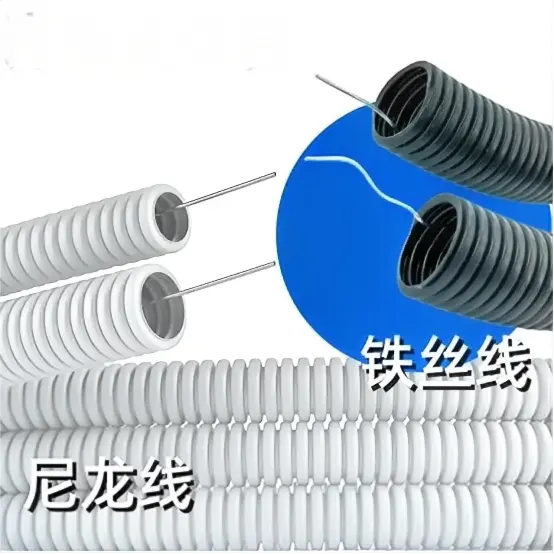
When we use single wall corrugated pipe machine to make corrugated pipe, there are various types of wave crest shape can be made according to using requirements. The wave crest shape serves as the core structural parameter governing the ring stiffness, flexibility, impact resistance, stress distribution, fluid dynamics performance, and installation efficiency of single-wall corrugated pipes.
1. Mainstream Wave Peak Shape and Core Performance Influence
1. Trapezoidal wave (most commonly used in engineering, accounting for approximately 76%)
· The structure features are as follows: the crest is flat, the side wall is inclined, and the trough is mostly rounded.
· Performance impact
o High circumferential stiffness: The large support area of the wave peak plane provides strong resistance to radial compressive forces, enabling the realization of high-stiffness grades (SN4–SN16).
o Stress concentration: Stress concentration is easy to occur at the sharp corner of the wave peak, the maximum stress measured can reach 2.3 times of the average stress, and fatigue cracking is easy under long-term load.
o Impact resistance is generally poor: the sharp corner has poor impact energy absorption, and the impact strength of simply supported beam is usually low.
o Economy: high structural efficiency, less material consumption under the same stiffness.
· Application scenarios: Conventional projects with high stiffness requirements, such as municipal drainage, sewage discharge, and communication cabling.
2. Circular Arc / Sine Wave
· The structure features are smooth transition of the wave peak and valley without sharp corner.
· Performance impact
o The stress distribution is uniform: no stress concentration points, excellent fatigue and crack resistance, long service life.
o Good flexibility: strong axial and circumferential deformation ability, good ability to adapt to uneven settlement of foundation.
o Low stiffness efficiency: Under the same material usage, the ring stiffness is lower than that of the trapezoidal wave, requiring additional wall thickness or wave height compensation, which increases costs.
o The contact area of the wave peak is small, and the local compression is easy to be concave.
· Application scenarios: soft soil foundation, trenchless construction, frequent bending of cable routing and temporary drainage.
3. U-shaped wave
· The structure features are as follows: the crest is gentle, the trough is a large arc, and the whole shape is close to a rectangle with rounded corners.
· Performance impact
o The comprehensive performance is balanced: it has the rigidity of trapezoidal wave and the flexibility of circular wave, and the stress distribution is more uniform.
o Excellent fluid performance: smooth inner wall, low fluid resistance, strong self-cleaning ability, and resistance to mud accumulation.
o Stable installation: The large contact area on the outer surface prevents rolling during installation, facilitating secure construction.
· Applicable scenarios: farmland drainage, rainwater collection, and municipal pipelines with moderate loads.
4. V-shaped wave
· Structural features: sharp crests, narrow troughs, and small lateral wall angles.
· Performance impact
o High local stiffness: The wave peak has strong anti-puncture and anti-impact ability, which is suitable for conveying solid particles.
o Extremely poor flexibility: difficult to bend axially and prone to fracture at the bending point.
o The stress concentration is serious, and the crack is easy to occur at the sharp angle of the wave peak and valley, so the wall thickness should be thickened to compensate.
· Application scenarios: industrial waste residue transportation, mine drainage, and special impact-resistant working conditions.
5. Composite/curved wave (e.g., S-Rib)
· The structure features are the micro-arc at the top of the wave crest and the transition of the side wall curvature, which combine the advantages of trapezoidal and circular wave.
· Performance impact
o Collaborative enhancement: While maintaining high ring stiffness (e.g., SN8), the impact strength of simply supported beams can be increased by over 20%.
o Stress optimization: Eliminating sharp corners significantly reduces stress concentration and enhances long-term reliability.
o The cost is higher because of the complex mold and process.
· Applicable scenarios: high-standard municipal projects, trenchless pipe jacking, and long-distance buried pipelines.
II. Systematic Influence of Waveform on Critical Performance
|
Performance dimension |
trapezoidal wave |
Arc / Sine |
U-shaped wave |
V-wave |
|
ring stiffness |
up to the hammer |
same as |
fine |
fine |
|
flexibility |
same as |
up to the hammer |
fine |
Poor |
|
stress distribution |
Concentrated (sharp angle) |
even |
More uniform |
severe concentration |
|
resistance to impact |
same as |
fine |
fine |
up to the hammer |
|
fluid resistance |
centre |
small |
minimum |
Large (tend to accumulate dirt) |
|
Installation stability |
centre |
Easy to scroll |
good |
centre |
|
material economy |
optimal |
higher |
good people |
Low (thickened) |
III. Core Principles of Model Selection
1. Stiffness priority: heavy load, deep burial, high soil cover scenarios → select trapezoidal wave or composite wave.
2. Flexible priority: soft soil, settlement sensitive, non-excavation → select arc wave or U-shaped wave.
3. Fluid priority: drainage, sewage discharge, and anti-clogging → select U-shaped wave or arc wave.
4. Impact resistance priority: convey solid-liquid mixture, mine, industry → select V-wave or composite wave.
5. Cost priority: conventional municipal and threading → trapezoidal wave is preferred.
IV. Synergistic Effects of Peak Supporting Parameters
The optimal performance of the wave crest shape can be achieved by the coordinated design of wave height, wave spacing and wall thickness.
· Wave height: The higher the wave height, the higher the ring stiffness, but the flexibility decreases and the material increases.
· Wave spacing: If the wave spacing is too small, the axial stiffness becomes excessively high, which is unfavorable for settlement adaptation; if the wave spacing is too large, the circumferential support becomes insufficient, leading to local buckling.
· Wall thickness: For sharp-edged waves (trapezoidal or V-shaped), the wall should be appropriately thickened at the wave crest to mitigate stress concentration.
Related News
- Advantages of Rubber Soaker Irrigation Pipes vs Traditional Irrigation Tubes
- Can Yongte Supply Turnkey Project Service for WPC decking plant?
- 200x50mm Recycled Solid Plastic Lumber Machine Tested Successfully
- Yongte WPC Column making machine with co-extrusion is successfully tested
- How can plastic film wastage be used to produce wood-plastic composite (WPC) products?
- WPC Extrusion Machine Temperature Setting
Leave me a message